Pull up Herriman on one home search site and the median price reads $632,000 for August 2026. Check a second source and it's $587,000. Pull the number straight from what actually closed through the Wasatch Front MLS in May and it drops again, to $572,500. Same city. Same general window. A swing of nearly $60,000 depending on which number you happened to click first.
That's not a typo somewhere in the data. It's a real signal about how homes are being priced in Herriman right now, especially inside the new-construction communities that make up a large share of what's currently for sale. If you're comparing Herriman to South Jordan or Riverton using whatever median you found on the first site you opened, you're working with a number that may not describe the home you're actually looking at.
Three ways to measure the same city
Here's what each of those figures is actually counting, and over what stretch of time.
| What's being measured | Figure | Time window |
|---|---|---|
| Median asking price, all active listings | $632,000 | August 2026 |
| Median sold price, trailing three months | $587,000 | Through May 2026 |
| Median sold price, MLS closings only | $572,500 | May 2026 |
| Median asking price, unsold inventory still sitting | $559,950 | May 2026, down about 10% year over year |
Look closely at the bottom row. Homes that haven't sold yet are asking less, on average, than homes that already closed. That's backwards from how most housing markets behave, where unsold inventory usually asks more than what buyers end up paying. In Herriman it means a meaningful chunk of active listings have already been marked down and still haven't found a buyer, while a different set of homes closed above that reduced price entirely.
A list-to-sold gap of a few percent is normal in any market. A gap this size, with unsold homes pricing below sold ones, tells you two different populations of listings are being blended into one median. One of the biggest reasons is new construction, and the way builders are choosing to discount it in 2026.
A price cut is public. A rate buydown isn't.
Here's the mechanism, and it's specific to how homebuilders in Utah are pricing right now rather than something baked into the housing market generally.
When a builder cuts $30,000 off the sticker price on one lot, that new number becomes the closed comp an appraiser uses on the lot next door, and on every other home in that phase already under contract at the old price. A price cut is recorded. It shows up in the county's sale records and in every appraisal that follows. That's expensive for a builder managing dozens of homes across several phases of the same community.
A rate buydown doesn't have that problem. If a builder pays down a buyer's interest rate to a fraction of the market rate, or hands over a closing cost credit, the recorded sale price never moves. The buyer's monthly payment drops, sometimes substantially, but the number that becomes tomorrow's comp stays exactly where the builder wants it.
That's why Utah builders in 2026 have leaned so heavily on financing incentives instead of sticker discounts. Incentives statewide now commonly run as high as 10 percent of a home's value. In neighboring Utah County, where several of the same builders active in Herriman also build, incentive packages of $15,000 to $60,000 per home have become standard this year. None of that shows up as a lower list price. All of it shows up as a lower payment, which is exactly the number a buyer actually cares about and exactly the number a citywide median doesn't capture.
There's a second layer worth knowing if you're a first-time buyer. Utah Housing Corporation runs a program offering up to $20,000 toward down payment or closing costs on new construction priced under $450,000, and it's stackable with whatever the builder is already offering. As of early 2026 the program had already funded roughly 2,934 households at an average of just under $20,000 per loan, which means it's popular enough that allocations can run out mid-year. If you're shopping new construction under that price point, it's worth confirming availability before you get attached to a specific floor plan.
What this looks like inside specific Herriman communities
The pricing gap isn't theoretical. It shows up lot by lot.
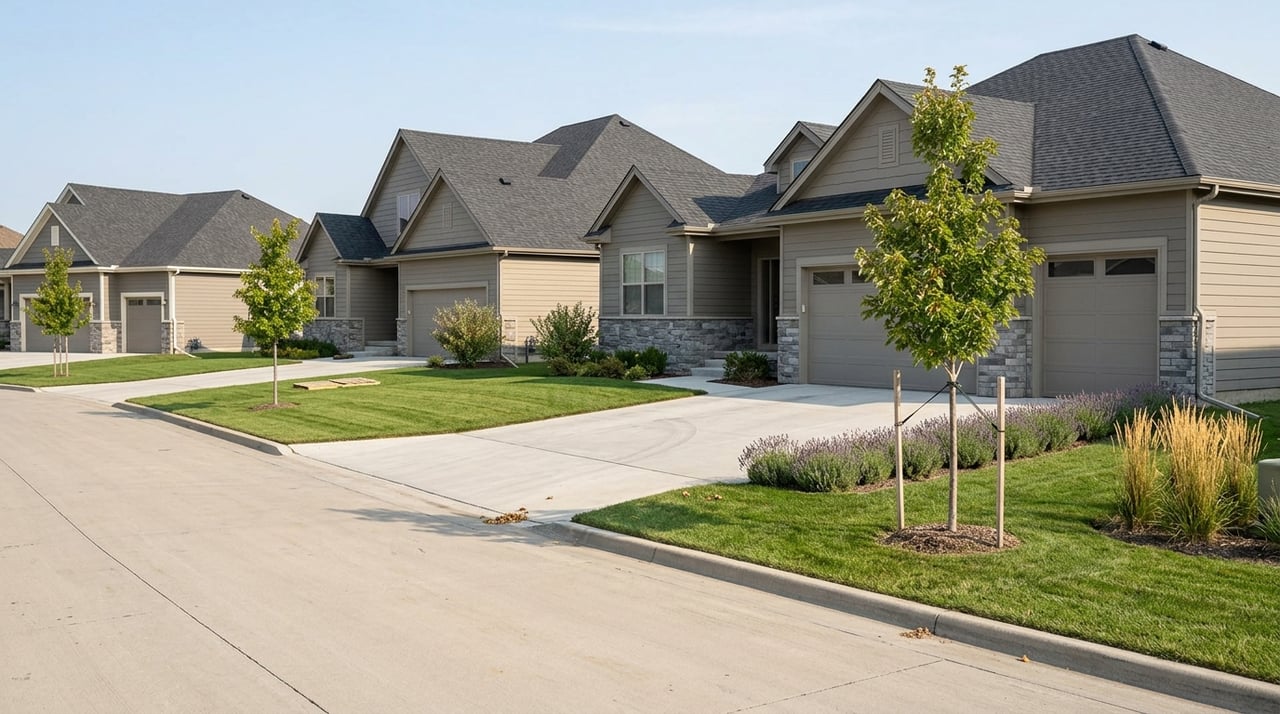
- Mountain Ridge is currently building homes from a base price around $554,900, with typical layouts running three to five bedrooms and about 3,450 square feet, and HOA dues that range from $50 to $200 a month depending on the phase and amenities attached to that section of the community.
- Two homes actively marketed in Herriman this year both carried an advertised 1.99 percent rate rather than a price reduction. One, a three-bedroom finishing construction in mid-June 2026, listed an estimated payment near $2,540. A larger four-bedroom finishing in July 2026 listed an estimated payment near $3,280. Neither listing shows a discounted price. The savings live entirely inside the financing.
- A current listing in The Cove at Silver Sky uses the same structure, offering a $21,000 preferred-lender credit rather than lowering the price of the home itself.
- Rosecrest complicates the comparison further because it isn't one HOA, it's several layered under a master association, with sub-communities like Boulders at Rosecrest and Juniper Bend at Rosecrest each carrying their own dues on top of the master fee. A resale home nearby with one flat HOA payment can look like a better deal on paper until you add up what a new-construction home in Rosecrest is actually carrying.
One caution worth passing along if you're the one shopping: an advertised rate like 1.99 percent is almost always a temporary marketing rate used to calculate the sample payment on the listing, not necessarily the rate you'll actually lock. Ask the builder's lender to show you the real note rate and the real payment side by side, in writing, before you factor either number into your decision. That's the same due diligence we walk buyers through when comparing conventional and FHA financing on Herriman new construction.
Why days on market told three different stories too
The pricing confusion has a matching problem in how long homes are taking to sell. One measure puts the current median at 117 days for homes actively listed in August 2026. Another, tracking only homes that actually went under contract, puts it at 24 days for May 2026. A third, averaging closed sales over three months, lands at 48 days.
These aren't contradictory so much as they're measuring different populations. Homes that are priced right, in a community buyers actually want, or paired with a strong builder incentive, are moving in well under a month. Homes that are overpriced, dated, or competing head-on against a new-construction payment backed by a rate buydown are the ones sitting for months and dragging that headline 117-day figure upward. Herriman right now isn't a slow market or a fast one. It's both at once, split by how well a given listing is positioned against what else is available a few streets over.
That matters most if you're selling a resale home here this year. Your real competition may not be the similar house two blocks away. It may be a builder up the road offering a payment three points below what a bank would quote you on the same loan amount. Pricing and positioning a resale listing against that reality is different from pricing it against last year's comps, and it's worth working through before you list.
Frequently asked questions
Is a rate buydown actually worth more than a straight price cut? It depends on how long you plan to stay in the home. For buyers who expect to hold the loan more than about five years, a permanent rate buydown typically delivers more total savings over time than a one-time closing credit. For buyers who expect to move or refinance sooner, the upfront credit toward closing costs can matter more than a rate that won't be locked in for long.
Which Herriman number should I actually trust? None of them by itself. Treat the citywide median as a rough temperature check and nothing more. The number that actually matters is the closed comp inside the specific community and phase you're considering, since incentive structure, lot premium, and build timing move an individual project's pricing far more than they move the city as a whole.
Does any of this affect people selling a resale home, not just buyers? Yes, and often without them realizing it. Appraisals draw on nearby closed sales, including new-construction homes that sold at full sticker price with a rate buydown attached off the books. A resale seller benchmarking against those closed prices is looking at the same inflated comp a new-construction buyer saw, without the financing incentive that made the number work in the first place.
If you're trying to make sense of what a specific Herriman listing, new or resale, actually costs once you look past the number on the sign, that's the exact kind of comparison we walk clients through every week. Tricia Vanderkooi works this market from inside the Wasatch Front, not from a national aggregator feed, and can pull the closed comps for the specific community and phase you're weighing. Start with a free home valuation or take a closer look at what's currently active in Herriman before you compare it to anywhere else on your list.